San Francisco Magazine
© March 2005
Chang, Interrupted
The fearless author's suicide made at least one thing clear: her subject matter was far more harrowing than anyone realized.
By Connie Matthiessen
Suicide always provokes the question: why? But in the case of historian Iris Chang, whose 1997 book The Rape of Nanking: The Forgotten Holocaust of World War II ripped the veil off one of the most brutal massacres of the 20th century, the reaction has been especially bewildered. Chang was discovered last November in her car on an isolated dirt road outside Los Gatos, dead from a single gunshot wound. It seemed an inconceivable end for the 36-year-old author and mother, whose ambition and promise, energy and courage in the face of vicious criticism provoked by her work made her a hero on two continents and a role model for a generation of scholars and activists around the world. Almost as soon as news of her death leaked out, conspiracy theorists were burning up the Internet, venting their grief and suspicions on online forums like Quick Topic. Right-wing Japanese nationalists, who had reacted with fury and hate mail to the Nanking book, seemed the obvious suspects: "No need for finger pointings [sic]," read one posting. "Japs are behind this greatest criminal conspiracy of the twenty-first century. Japs murdered Iris Chang."
While those closest to Chang were as stunned as anyone else by her death, they had no trouble believing it was suicide. Chang had been clinically depressed for months, including a brief hospitalization in August while she was in Kentucky, conducting interviews for her next project. At Chang's request, her family kept her depression secret; besides her understandable desire for privacy, she was afraid her critics might use any sign of psychological weakness as another reason to dismiss her work. Chang's family says she was a reluctant patient. "Iris was a very impatient person," says her father, Shau-Jin. "She couldn't stand being sick." She apparently never opened up to her psychiatrist, says her mother, Ying-Ying. "She told us more than she told her doctor."
"She wanted to be in control," says Brett Douglas, her husband of 13 years. "She would only meet with psychiatrists if she had final say on medications." When the drugs didn't work fast enough, she just got more frustrated and discouraged. Writer Paula Kamen, a friend since college, hadn't heard from Chang for months but assumed that she was just busy, until a mutual acquaintance told her Chang was sick. Shortly after that, Chang called, and Kamen was shocked by how bad she sounded. "It was beyond depression," Kamen says. "She wasn't talking rationally. She was out of touch with reality."
Still, Chang seemed to be doing better later on—well enough, the weekend before her death, to visit a spa in Santa Cruz and go out to dinner and a movie (Ray) with her husband. "She didn't seem the least bit suicidal, and her depression seemed to be lifting," Douglas says. When her agent and longtime friend Susan Rabiner spoke to Chang the night before her death, "her voice was sad, flat—it had no affect. But she didn't sound hopeless," Rabiner says. "We made plans for her to come and visit me. I don't think any of us expected this."
In the note Chang meticulously wrote and edited and left beside her computer, she said she wished to be remembered "as the woman she was before her illness, engaged with life, committed to her causes, her writing, and her family," her husband says. Those closest to Chang hope that in the end she will be remembered for her life, not her death.
But her friends believe that her death also carries lessons that shouldn't be ignored. "It is important for people to know that even someone we admire for their strength, like Iris, can suffer from depression, with devastating effects," says the writer Helen Zia. Indeed, four months after her suicide, it seems clear that the very qualities that made Chang such a gifted chronicler of human suffering—her empathy, compassion, deep sense of justice, even her amazing drive and determination—may have made her work increasingly painful and at the same time made it difficult for her to seek help until it was too late.
In July 1937, Japanese soldiers invaded China. After subduing Shanghai in a battle that lasted for months, they surrounded Nanking (now Nanjing), the newly established capital. First, they systematically slaughtered tens of thousands of Chinese soldiers despite promises that those who surrendered would not be harmed. Some were gunned down, others were used for bayonet practice, and still others were burned alive.
Next, the Japanese troops turned on civilians. Babies were sliced to pieces. Women, young and old, were raped over and over again, then mutilated and left for dead. No one knows exactly how many Chinese were butchered, but experts believe the figure exceeds 300,000. The Yangtze River, it was said, ran red with blood for days.
The Nanking slaughter was only one particularly vicious chapter in the savage history of the Japanese occupation. For eight years, the Japanese terrorized the Chinese population, wiping out entire villages, experimenting with biological weapons, and forcing women into sexual slavery. Historians estimate that 10 million Chinese were murdered; another 9 million died from starvation and disease. But Pearl Harbor, Hiroshima, and Auschwitz overshadowed these atrocities, and after the war, the demands of geopolitics buried the Nanking corpses deeper still. The United States needed Japan as an ally to counterbalance the growing threat of Russia and, later, Communist China. Only a handful of Japanese officials were tried for their crimes in China; significant reparations were never made. China itself joined the conspiracy of silence, for its government viewed Japan as a key partner in the country's postwar economic revival.
But in China and émigré communities around the world, the rape of Nanking was a familiar story, passed down from generation to generation. Chang heard the horrific tales from her parents and Ying-Ying's parents, who had fled the city a month before the Japanese invaded. Ying-Ying and Shau-Jin, both distinguished scientists (she is a microbiologist, he is a physicist), grew up in China, Taiwan, and Hong Kong, then came to the United States in 1962 as fellowship students at Harvard. The Changs spent most of their careers teaching and conducting research at the University of Illinois at Urbana-Champaign, where Iris eventually attended college. The slaughter was a gruesome topic of discussion around the dining room table. "Their voices quivering with outrage, my parents characterized the Great Nanking Massacre, or Nanjing Datusha, as the single most diabolical incident committed by the Japanese [in the war]," Chang wrote. "Throughout my childhood, Nanjing Datusha remained buried in the back of my mind as a metaphor for unspeakable evil."
It's hard to overstate the importance of Chang's role in bringing the Japanese atrocities to global attention. Until The Rape of Nanking, the only lengthy accounts had been written in Chinese, which meant they received scant notice in the international press. The world's silence compounded the slaughter's psychic toll. "The Nanjing massacre was a monumental event in Sino-Japanese relations," says China scholar Orville Schell, who heads the UC Berkeley Graduate School of Journalism. "It resulted in an almost Freudian repression, because it was never properly acknowledged. After World War II, Germany's faults were aired and digested, and penance was paid. This never happened between the Japanese and the Chinese. And then along comes Iris Chang."
"She ripped the scab off an unhealed wound," adds Schell, who gave the book an admiring review in the New York Times. "I believe that incidents of this magnitude need to be revealed, digested, acknowledged, and forgiven. Otherwise, they remain as a subcutaneous toxic substance that never really goes away."
By the time Chang decided to tell the monumental story of Nanking, she had already published one well-received book, Thread of the Silkworm, about Tsien Hsue-shen, the father of China's missile program, who was falsely accused of spying during the McCarthy era and deported from the United States. She was just 26. "She looked even younger than she actually was," recalls activist Ignatius Ding, who first encountered her in 1994 poring over photos of mangled bodies at a conference on the Japanese atrocities that he helped organize. For all of Chang's seriousness, Ding mistook her for a high school student working on a term paper. "I told her that it was an odd subject for a book report," he recalls. "?‘I am a book author,' she told me. ‘I am a professional.' And I thought, ‘Oh, sure!'?"
The images Chang viewed that day—the first of the massacre she'd ever seen—had a searing effect. "I walked around for an entire day in a state of shock," Chang later recalled. "In a single blinding moment, I recognized the fragility of not just life but the human experience itself.... I was suddenly in a panic that this terrifying disrespect for death and dying, this reversion in human social evolution, would be reduced to a footnote of history...unless someone forced the world to remember it." Ding and Chang became friends and, along with other Chinese American activists, founded the Global Alliance for Preserving the History of WWII in Asia, which assisted her research. Almost fluent in Mandarin, Chang spent months in China, interviewing survivors, examining private papers, retracing the steps of persecutors and persecuted alike.
Susan Rabiner, Chang's editor at Basic Books during the project, compares her friend to the sons and daughters of survivors of the Nazi Holocaust: "We know far more about the European theater during World War II than we do about the Pacific theater in part because Jewish American kids researched the death camps and got the information out." Chang became China's one-woman version of the Holocaust movement, Rabiner says: "She broke new ground so others could follow in her footsteps."
Chang's timing was impeccable. The Rape of Nanking appeared at a moment when second- and third-generation Asian Americans were hungry to under stand Japan's role in World War II. To her astonishment, the book was a blockbuster, on the New York Times best-seller list for ten weeks. And practically overnight, Chang went from being a talented but relatively unknown nonfiction writer to the passionate and seemingly tireless spokesperson for an international movement that touched tens of millions of people. San Francisco Superior Court Judge Julie Tang, former cochair of the Rape of Nanking Redress Coalition, one of a number of groups spawned by Chang's work, regards her with awe. "Iris took on an incredible burden—she took on history," Tang says. "She was willing to be the lone voice, the only one to raise these dirty secrets and demand that the world pay attention." "My grandmother talked about World War II atrocities," recalls Judy Ma, an aspiring San Francisco filmmaker. "But they were just stories—they didn't have any reality for me. There was nothing to validate her tales; we never learned anything about it in school." Then, Ma met Chang at a conference in 2001. "After I heard Iris talk, it stirred a passion in me to find out more." Ma is currently making a documentary about the slaughter.
Chang's sense of mission was fueled by Japan's refusal to acknowledge that the Nanking massacre had even happened, much less to apologize and offer redress. Not surprisingly, conservative scholars and the Japanese government reacted to the book's phenomenal success with scathing attacks on her research, her statistics, her motives, and her professionalism. Chang never backed down. Helen Zia, whose own father was haunted by the massacre of his mother, brother, and sister-in-law, recalls Chang's appearance on NewsHour: "She was this fresh-faced young woman on television with the Japanese ambassador. He was trying to discredit the book, claiming it was full of lies and fabrications. Iris sat there unwavering, with a spine of steel, her voice controlled, and she was unrelenting. It was amazing to watch. She just demolished him."
One of Chang's major achievements was to spur the Chinese government to end its long silence about the Nanking slaughter. Her revelations also provoked soul-searching in Japan, but the deniers continued to hold sway there, in part because her book never appeared in a Japanese edition (plans for one were canceled when the publisher demanded changes and excisions that Chang refused to approve). If conspiracy theorists around the world were quick to conclude that the Japanese right wing was behind her death, some Japanese conservatives seized upon her mental state as proof that Chang was delusional—just as she had feared they would. One contributor wrote in the online Japan Today forum, "She was psychotic most likely already when she wrote that silly book of hers."
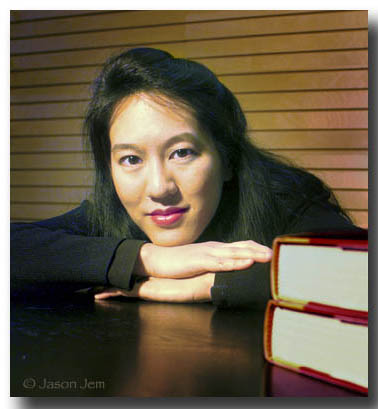
Chang had her critics, but most of those who knew her were dazzled. "Iris was so strong," says her brother, Michael, an engineer at a software company in San Jose. "She wasn't someone who I ever worried about." "Bright eyed," "curious," and "happy" is how Rabiner describes her: "When she entered a room, it would light up." She was also strikingly beautiful—tall, dignified, with flawless posture and a penetrating gaze. "I was struck by the intensity of her eyes," her husband said in his eulogy, recalling their first real conversation, at a college party. "She carried herself like a queen."
She exuded discipline and focus, Rabiner says. The two first met when Chang, fresh out of grad school at Johns Hopkins, proposed a book on a physicist named John Bardeen. Rabiner passed, but impressed by Chang's nerve, suggested she take on the forgotten story of Tsien Hsue-shen. Rabiner was hard-pressed to imagine that someone so green would have the skills or persistence to follow through. But Chang surprised her by rapidly finishing Thread of the Silkworm, becoming one of the youngest authors in Basic Books' history.
Her confidence was infectious. Paula Kamen was a struggling freelance journalist when she wrote an op-ed piece that she hoped to place in a local alternative paper. Chang encouraged her instead to pitch the New York Times, which took the piece, helping launch Kamen's career. On the lecture circuit, Kamen would encourage students to "Iris Chang it," that is, to think big. "She had become a verb to me," Kamen said in her eulogy. "An action verb."
But Chang was also extremely sensitive, in a number of ways. "She was a very emotional person," Chang's father says. In his eulogy, Douglas recalled the time he tried to persuade her to join him and some friends on an outing to the beach in Santa Barbara. Chang, who wanted to stay home and work, told them she didn't like the beach: "The sand makes little cuts in my feet, and the saltwater lashes at my wounds."
That sensitivity was one of her greatest assets as a journalist and historian, Kamen believes. "Part of the power of her interviewing was that she had no filters to block out anything that was being said to her. I suspect that she didn't even know people came with filters.
"Iris wasn't a jaded, hardened reporter," Kamen says. "She was an innocent, vulnerable person. A lot of journalists develop a sort of gallows humor; I see that as a defense mechanism, a means of distancing oneself. Iris would never joke about her work. That was why Iris was such an amazing reporter: she felt everything so deeply. There were no boundaries between herself and the things she was reporting."
Yet this is where Chang's problems may have begun. Her inability to distance herself from her work may have made her vulnerable to what psychologists call secondary, or vicarious, traumatization, a form of post-traumatic stress disorder (PTSD) that can be a problem among therapists, emergency workers, translators, and journalists. Bay Area psychologist Tato Torres, a PTSD expert who has treated torture survivors, points out that for Nanking victims, the lack of acknowledgment exacerbated the trauma. "Iris Chang sought out and talked to people who had never told their stories before," he says. "The trouble is, these stories are toxic. They create extreme disorganization in the person who experienced them, as well as an altered sense of self. Even a highly trained therapist would have had a hard time dealing with that level of trauma. Iris Chang was doing this difficult work without training, without social support."
"We hear about some of the most atrocious acts imaginable," says Uwe Jacobs, a neuropsychologist and therapist who directs Survivors International, a San Francisco-based nonprofit that works with torture survivors from around the world. "A person [in Chang's shoes] may become despairing, disgusted at what people are capable of. There is a limit to how many times you can hear these stories without developing symptoms of secondary trauma." This is why his group's therapists and counselors see a limited number of clients. "There are people who can do this work all the time and not become symptomatic, but they are more the exception than the rule."
Chang was open about the "disturbing—in fact devastating" experience of writing the book. "I might be taking a walk or taking a shower and one of the photographic images from the massacre might pop up before my eyes. Those images are seared in my brain forever. Once you see images of atrocities, you can't ever unsee them." In China, she spent hours at a time with the people she interviewed. When she returned from trips, she was always haggard and run-down. "She told me that she would sit in the dark, surrounded by the photos of the victims in her study, unable to produce a word all night because of her nightmares," Ding told one reporter. Her weight plummeted and her hair fell out.
But if the work was difficult for her, Chang was reluctant to admit it. In an interview published in the Bloomsbury Review in 2003, Chang was asked how she coped. "Who am I to shy away from this topic and to complain about pain," she replied, "when hundreds of thousands of people died the most horrible deaths imaginable, people whose voices might be lost, forever, to oblivion?"
Nor did Chang give herself much chance to recover after the book was published. Her family urged her to slow down, but she didn't feel she could. She was constantly being asked to speak on behalf of one cause or another or to write a blurb or a testimonial, and she seldom said no, even if it meant going without sleep for days at a time. "She always pushed herself right to the limit," Douglas told the Chronicle soon after her death. "She would work until she crashed."
In 2003, Chang published her next book, The Chinese in America. Though the book explored some ugly topics like racism and violence, Chang told interviewers that working on it was "like a vacation" compared with Nanking. While she was putting on the finishing touches, she gave birth to her son, Christopher. Around this time, her parents, now retired, moved to San Jose, settling a few doors away from their daughter and her family.
It was a comparatively happy time, but at least one friend has suggested that Chang may have suffered from postpartum depression (PPD). One in six new mothers experience PPD; if left untreated, it can persist or worsen. Michael Chang says that his sister set very high standards for herself. "Some women take a few years off when they have a child, or they work part-time," he points out. "Not Iris—she wanted to keep working at the same pace, and to be a great mother, too. She was determined to do it all."
It's unclear whether Chang, whom so many put on a pedestal, felt any stigma about her depression. But a growing body of research shows that Asian Americans, partly for cultural reasons, are significantly less likely to seek help for mental health problems than other populations. "You don't complain," says Betty Hong of Asian Community Health Services in Oakland. "You don't talk about your problems. You always have to present a strong, successful face to the outside world." Many seek help only when the condition becomes very serious—which makes it harder to treat.
Complicating Chang's situation, she once again plunged into a painful and long-ignored episode of World War II: the Bataan Death March.
In April 1942, 70,000 American and Filipino soldiers surrendered to the Japanese in the Bataan peninsula of the Philippines. The captives were forced to walk almost 60 miles in searing heat without food or water. Those who collapsed were shot or beaten to death; those who survived endured four more years of torment as prisoners of war and slave laborers. Two out of three died before the end of the war.
Chang had always wanted to do an oral history on the war's Pacific theater. What drew her to the Bataan project, Douglas says, was profound sympathy for the American veterans, many from small towns, who'd suffered so horribly but had never gotten their due from the U.S. government.
The echoes of Nanking were obvious. The project promised to light more fireworks in Japan. Was anyone worried that the topic might be too distressing for Chang to handle at this point in her life? "I didn't like to hear the stories she told me [about Bataan]," Douglas admits. "[But] I don't think anyone was concerned because she seemed to handle the Rape of Nanking subject so well."
Yet this time, it may have been too much. "I could see times when Iris was visibly shaken by the stories the [men] told," recalls Anthony Meldahl, a former intelligence officer and military historian who helped interest Chang in the project and accompanied her on a number of interviews in the Midwest. Adding to her despair was the age of the survivors. "The men she was interviewing were in their 80s," Douglas says. "She would develop a relationship with them, then would get very upset when she heard one of them died."
Yet for this reason, Chang didn't feel she could wait. Douglas says she was already exhausted in August when she traveled to Kentucky for more interviews. While there, she had a breakdown and was hospitalized for three days. After her return, she and Rabiner agreed that she would stop work on the Bataan project, at least temporarily.
By last October, Chang's mental state had become serious enough that she and her husband sent Christopher, 2, to stay with Douglas's parents in Illinois. Without anyone's knowledge, Chang purchased an antique pistol at a local gun shop. On November 9, she used the gun to end her life.
Today Julie Tang muses, "A lot of us feel guilty that we didn't intervene and help in some way. She was always being approached to help at this event, to speak at that conference. I began to hear weariness in her voice. Signs of stress. Now I wish we'd taken time to focus on her—not just as a wonderful spokesperson but as a person with needs and problems of her own."
But would Chang have stopped what she was doing even if she knew the eventual cost? Her single-minded determination to bear witness and right the wrongs of history might well have blinded her to signs of her own distress. Could she ever have imagined another path for herself? If she had taken it, would she still have been the person she wanted to be?
"I see my parents almost every day, and [her death] is all we talk about," says Michael Chang. "We go over it again and again in our minds. ‘Could we have done this? Should we have done that?' There is no point in going there, and yet you do. You know you would have done anything you could to prevent this."
Rabiner also points out the futility of attempting to find reason behind an act that was beyond reason—and probably ultimately beyond anyone's ability to grasp. "If Iris had died of cancer, no one would ask why," she says. "Iris had a clinical depression, which is a disease. Her brain chemistry hijacked her rational mind."
She finishes simply, "It's a tragedy. It makes no sense."?
Writer Connie Matthiessen lives in San Francisco.