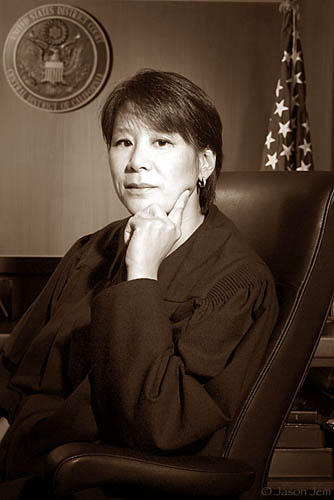
Judge Jennifer Lum's path onto a legal career was natural because her father was also a pioneering Chinese-American attorney. "I was always in that environment, being constantly surrounded by law."
Judge Lum remembers, "Growing up in America's south, Memphis, Tennesee, I saw a lot of racial discrimination." which created added incentive for her to study law. She adds, "I enjoy working in the legal profession because it has value to society and directly impacts people. It is also very intellectually rewarding."
Before being appointed as a Magistrate Judge at United States District Court, Central District of California, Jennifer Lum served 13 challenging years in the United States Attorney's Office - Criminal Division, as the Chief of Major Frauds Division, where she was responsible for the investigation and prosecution of white collar crimes, including securities fraud, computer crimes and Internet fraud, intellectual property crimes, bank fraud, bankruptcy fraud, telemarketing fraud and insurance fraud. In that position, she supervised approximately 25 Assistant United States Attorneys and numerous other support staff.
Judge Lum had also worked with private practice law firms and was a law clerk to Judge Dickran Tevrizian, also with the United States District Court, Central District of California in Los Angeles. With experience on both sides of the 'bench' Judge offers these opinions on the differences between being an attorney and a judge. "As an advocate or an attorney, she and her client lives or dies [figuratively] by a legal decision. The stakes are greater." Judge Lum then shifts over to describing her role behind the bench and how she deals with deciding on conflicting, paradoxical issues, "The law is not always clear. It can be very difficult and very hard. A judge has to consider all the information and how the existing law covers the case, make the hard decision based on the best information and resources and move on." She also adds, "Settlement conferences can be extremely complex and tortuous."
For students considering studying law, Judge Lum offers this, "An education in law is not just limited to the legal field. It creates a foundation for critical thinking to solve difficult problems and issues. Of course, it is also very useful and important for getting into politics."
How does Judge Lum view Chinese Americans in America? "Even though we are well on our way and have made a lot of progress, we still need to be more vocal and get more involved in government and politics."